PPO vs HDHP: Save $1,200 Annually on Health Benefits
Advertisements
Latest developments on Comparing PPO vs HDHP Benefits: Which Setup Saves You at Least $1,200 Annually?, with key facts, verified sources and what readers need to monitor next in Estados Unidos, presented clearly in Inglês (Estados Unidos) (en-US).
Comparing PPO vs HDHP Benefits: Which Setup Saves You at Least $1,200 Annually? is a critical decision for millions of Americans navigating their healthcare options. This choice often dictates not only access to medical care but also significant financial outcomes, directly impacting household budgets.
Understanding the nuances between Preferred Provider Organization (PPO) and High-Deductible Health Plan (HDHP) is essential for optimizing healthcare spending. With rising medical costs, selecting the right plan can lead to substantial savings, potentially exceeding $1,200 each year.
This article provides a comprehensive, objective analysis of both plan types, focusing on their structures, costs, and suitability for different healthcare needs. The goal is to equip readers with the knowledge necessary to make an informed decision that aligns with their financial goals and health priorities.
Understanding PPO Health Plans: Structure and Advantages
PPO plans are characterized by their flexibility and broader network of providers, allowing members to see specialists without a referral. This freedom comes with a specific cost structure, typically involving higher monthly premiums but lower out-of-pocket costs for services.
Members often have co-pays for doctor visits and prescriptions, and deductibles are generally lower compared to HDHPs. The plan covers a percentage of costs after the deductible is met, usually at in-network rate, offering predictable expenses for frequent users of medical services.
This structure is particularly appealing to individuals or families who anticipate regular medical needs, prefer a wide selection of doctors, and are willing to pay a higher premium for that convenience and predictability. The higher monthly cost can be offset by reduced expenses at the point of service.
Key Features of PPO Plans
PPO plans offer a vast network of healthcare providers, giving members more choices when selecting doctors and hospitals. The ability to visit specialists without prior authorization is a significant advantage, streamlining access to specialized care.
While premiums are generally higher, the co-payments for routine visits and prescriptions are often fixed and relatively low. This predictability in cost can be a major draw for those who value knowing their immediate expenses upfront, particularly for chronic conditions or frequent check-ups.
- Broad Provider Network: Access to a wide range of doctors and specialists without referrals.
- Predictable Co-pays: Fixed costs for office visits and prescriptions, easing budget planning.
- Lower Deductibles: Typically, deductibles are lower than HDHPs, meaning insurance coverage kicks in sooner.
Who Benefits Most from PPO?
Individuals with ongoing health conditions or those who frequently visit doctors often find PPO plans more beneficial. The comprehensive coverage and lower out-of-pocket costs at the time of service can lead to significant savings over the course of a year, despite higher monthly premiums.
Families with children, who may require more frequent doctor visits or specialist care, also tend to favor PPO plans. The reduced administrative burden of not needing referrals and the extensive network simplify managing diverse healthcare needs.
For those who prioritize choice and convenience in their healthcare providers and are comfortable with a higher fixed monthly expense, the PPO model offers a compelling solution. It provides peace of mind through broader access and more immediate coverage for medical services.
Exploring HDHP Benefits: High Deductibles, Lower Premiums
High-Deductible Health Plans (HDHPs) are designed with significantly lower monthly premiums but require members to pay a higher deductible before the plan begins to cover costs. This structure shifts more of the initial financial responsibility to the consumer.
HDHPs are often paired with a Health Savings Account (HSA), which allows individuals to save money tax-free for medical expenses. The funds in an HSA can be used for deductibles, co-pays, coinsurance, and other qualified medical expenses, offering a powerful savings vehicle.
These plans appeal to individuals who are generally healthy, have minimal medical expenses, and are looking for lower monthly costs. The potential for substantial annual savings, especially when combined with an HSA, makes HDHPs a strong contender for cost-conscious consumers.
Advantages of HDHP with HSA
The primary advantage of an HDHP is its lower monthly premium, which can result in considerable savings throughout the year. For individuals with few medical needs, this translates directly into more disposable income.
Coupling an HDHP with an HSA introduces a triple tax advantage: contributions are tax-deductible, earnings grow tax-free, and withdrawals for qualified medical expenses are also tax-free. Unused HSA funds roll over year after year, acting as a long-term savings and investment vehicle.
- Lower Monthly Premiums: Significant reduction in recurring healthcare costs.
- Tax-Advantaged Savings: HSA offers tax-deductible contributions, tax-free growth, and tax-free withdrawals for medical expenses.
- Financial Control: Empowers individuals to manage their healthcare spending and save for future medical needs.
Ideal Candidates for HDHP
HDHPs are particularly suitable for young, healthy individuals who anticipate minimal medical care throughout the year. Their lower premiums can lead to considerable savings if medical services are rarely utilized, making them an attractive option for budget-conscious consumers.
Individuals who are proactive about managing their health and finances also find HDHPs appealing, especially when paired with an HSA. The ability to save and invest tax-free for future medical expenses provides a robust financial planning tool, aligning with long-term financial goals.
Those who have access to an employer-sponsored HDHP with an HSA contribution can maximize their benefits, potentially saving thousands annually. This combination offers a powerful incentive for healthy individuals to choose this plan type and actively manage their healthcare finances.
Cost Comparison: Premiums, Deductibles, and Out-of-Pocket
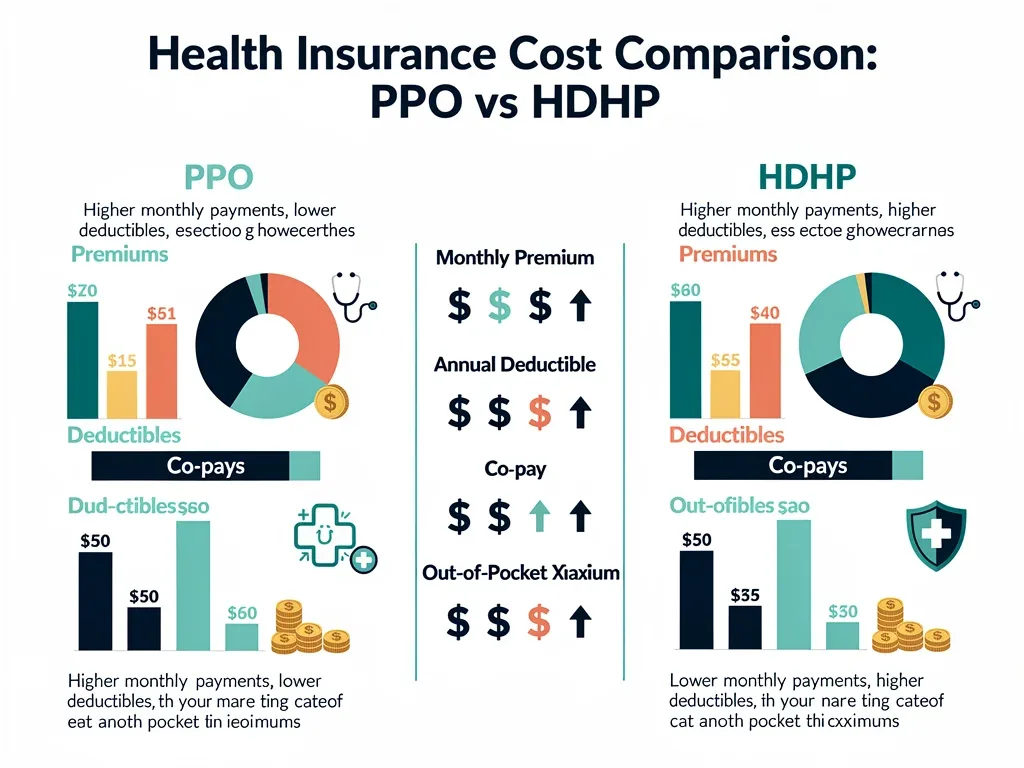
When Comparing PPO vs HDHP Benefits: Which Setup Saves You at Least $1,200 Annually?, a detailed look at premiums, deductibles, and out-of-pocket maximums is crucial. PPO plans typically feature higher monthly premiums, providing more comprehensive coverage from day one, often with co-pays for services.
HDHPs, conversely, boast lower monthly premiums but come with significantly higher deductibles that must be met before insurance coverage kicks in for most services. This means individuals pay more out-of-pocket initially, but their recurring costs are lower.
The out-of-pocket maximum is a critical figure for both plans, representing the most an individual will pay for covered services in a year. While HDHPs often have higher deductibles, their overall out-of-pocket maximums can sometimes be comparable or even lower than PPOs, depending on the specific plan details.
Understanding Deductibles and Coinsurance
A deductible is the amount you must pay for healthcare services before your insurance plan starts to pay. In PPO plans, deductibles are generally lower, meaning your insurance coverage begins sooner after you've paid a smaller initial sum.
For HDHPs, the deductible is substantially higher, requiring you to cover a larger portion of your medical expenses upfront. After meeting the deductible, both plan types typically shift to coinsurance, where you pay a percentage of the cost, and the insurance company pays the rest, up to the out-of-pocket maximum.
Understanding these thresholds is vital for anticipating your potential financial exposure. The higher deductible of an HDHP can be a barrier for some, but for others, it’s a trade-off for lower monthly premiums and the benefits of an HSA.
Access to Care: Networks and Referrals
Access to care is a significant differentiator when Comparing PPO vs HDHP Benefits: Which Setup Saves You at Least $1,200 Annually?. PPO plans offer extensive provider networks, allowing members to choose from a wide array of doctors and specialists without needing a referral from a primary care physician.
This flexibility is a major draw for those who value choice and direct access to specialized medical services. While HDHPs also typically offer a network of providers, the emphasis is often on cost efficiency, and some might have slightly narrower networks or different rules regarding out-of-network care.
For both plans, understanding the specific network is crucial to avoid unexpected out-of-network charges. Always verify if your preferred doctors and hospitals are included in the plan's network before making a decision.
PPO's Broad Network Advantage
PPO plans are renowned for their generous provider networks, offering members the freedom to select almost any doctor or hospital. This extensive choice eliminates the need for referrals, simplifying the process of seeing specialists and managing complex healthcare needs.
The ability to seek care from a wide range of providers, both in-network and sometimes out-of-network (albeit at a higher cost), provides unparalleled flexibility. This is particularly valuable for individuals who travel frequently or reside in areas with limited in-network options for specific medical conditions.
- No Referrals Required: Direct access to specialists, saving time and administrative steps.
- National and Regional Networks: Often provides access to a broader range of providers across different locations.
- Out-of-Network Options: While more expensive, PPOs usually offer some coverage for out-of-network care.
Financial Planning with HSAs: Long-Term Savings
The financial planning aspect of an HDHP, particularly when combined with an HSA, offers unique long-term savings opportunities. An HSA is a tax-advantaged savings account that can be used for current or future medical expenses, providing a powerful tool for healthcare cost management.
Contributions to an HSA are tax-deductible, the money grows tax-free, and withdrawals for qualified medical expenses are also tax-free. This triple tax advantage makes HSAs an attractive option for individuals looking to save for retirement or unexpected health events.
Unlike Flexible Spending Accounts (FSAs), HSA funds roll over year after year, building a substantial reserve for medical costs. This long-term savings potential is a significant factor in Comparing PPO vs HDHP Benefits: Which Setup Saves You at Least $1,200 Annually? for future financial security.
Maximizing HSA Benefits
To maximize HSA benefits, individuals should contribute the maximum allowable amount each year, if possible. This strategy not only reduces taxable income but also allows the funds to grow tax-free over time, significantly increasing your financial cushion for medical needs.
Consider investing your HSA funds once a sufficient cash reserve is established for immediate medical expenses. Many HSA providers offer investment options, allowing your money to grow even faster, much like a retirement account.
Using HSA funds strategically for qualified medical expenses, especially after retirement, can further enhance their value. These funds can cover Medicare premiums, long-term care insurance premiums, and other out-of-pocket medical costs, providing substantial financial relief in later life.
Real-World Scenarios: Who Saves What?
When Comparing PPO vs HDHP Benefits: Which Setup Saves You at Least $1,200 Annually?, examining real-world scenarios helps clarify which plan offers greater savings. For a healthy individual with minimal doctor visits, an HDHP with its lower premiums and potential HSA growth often yields significant annual savings.
Consider a person who only has an annual physical. The lower monthly premiums of an HDHP could easily save them hundreds of dollars compared to a PPO, even if they pay a small co-pay for the physical. The HSA contributions further amplify this benefit through tax savings.
Conversely, a family with chronic conditions or young children requiring frequent medical attention might find a PPO more cost-effective. The higher PPO premiums are offset by lower co-pays and deductibles, preventing large out-of-pocket expenses for numerous visits and prescriptions.

Case Study: Healthy Individual
A 30-year-old healthy individual, earning $60,000 annually, enrolls in an HDHP with a $3,000 deductible and a $150 monthly premium. They contribute $1,000 to their HSA annually. Their only medical expense is an annual wellness visit, covered at 100%.
Compared to a PPO with a $400 monthly premium and a $500 deductible, the HDHP saves them $250 per month in premiums, totaling $3,000 annually. Factoring in tax savings from HSA contributions, their net savings could easily exceed $1,200, demonstrating the financial power of an HDHP for low healthcare users.
This scenario highlights how lower premiums and tax-advantaged savings can make an HDHP the superior choice for individuals with predictable, low medical needs. The accumulated HSA funds also provide a safety net for unexpected future health events.
Case Study: Family with High Medical Needs
A family of four, with two young children, frequently visits the pediatrician and manages a chronic condition for one parent. They opt for a PPO with a $600 monthly premium, a $1,500 family deductible, and $20 co-pays for office visits.
An alternative HDHP option has a $300 monthly premium but a $6,000 family deductible. While the HDHP premium is lower, their numerous doctor visits, specialist appointments, and prescription costs would quickly exhaust the PPO's lower deductible and co-pays, leading to predictable expenses.
In this situation, the PPO's higher premiums are justified by the reduced out-of-pocket costs at the point of service, preventing the family from facing large bills for every medical encounter. The PPO offers financial predictability and peace of mind for high healthcare utilization, illustrating why Comparing PPO vs HDHP Benefits: Which Setup Saves You at Least $1,200 Annually? is not a one-size-fits-all decision.
Making the Right Choice: Factors to Consider
When deciding between PPO vs HDHP benefits, several factors should guide your choice to ensure you save at least $1,200 annually. Your current health status and anticipated medical needs are paramount, as these directly influence your out-of-pocket expenses under each plan.
Consider your financial situation, including your ability to cover a high deductible if choosing an HDHP, and your capacity to contribute to an HSA. The long-term savings potential of an HSA can be a significant motivator, but only if you can afford the upfront medical costs.
Finally, evaluate the importance of provider choice and referral requirements. If having direct access to specialists and a broad network is a priority, a PPO might be more suitable, even with its higher premiums. Understanding these factors is key to making an informed decision.
Assessing Your Healthcare Needs
A thorough assessment of your healthcare needs is the first step in making an informed decision. If you or your family members have chronic conditions, require regular specialist visits, or take multiple prescription medications, a PPO might offer better overall value despite its higher premiums.
For individuals who are generally healthy and only require occasional preventative care, an HDHP often proves more cost-effective. The lower monthly premiums combined with the tax advantages of an HSA can lead to substantial annual savings, especially if medical expenses are minimal.
Consider any planned procedures or upcoming family additions, as these can significantly impact your healthcare utilization. A clear understanding of your expected medical expenses will help you accurately project costs under both PPO and HDHP scenarios.
Strategies for Maximizing Healthcare Savings
Maximizing healthcare savings involves more than just choosing the right plan; it requires active engagement with your benefits. For those with an HDHP, consistent contributions to an HSA are crucial to build a robust fund for future medical expenses and leverage tax advantages.
Regardless of your plan type, utilizing in-network providers is essential to avoid higher out-of-pocket costs. Always verify that your doctors, specialists, and facilities are part of your plan's network before receiving care to prevent unexpected bills.
Comparing PPO vs HDHP benefits effectively means understanding the full financial picture, including potential tax benefits and long-term investment opportunities. Proactive management of your healthcare choices can indeed save you at least $1,200 annually, sometimes even more.
Leveraging Preventative Care and Wellness Programs
Both PPO and HDHP plans typically cover preventative care services at 100%, without counting towards your deductible. Taking advantage of annual physicals, screenings, and vaccinations is crucial for maintaining health and detecting issues early, often preventing more expensive treatments down the line.
Many employers and insurance providers offer wellness programs that can provide incentives or discounts for healthy behaviors. Participating in these programs can not only improve your health but also reduce your overall healthcare costs, contributing to your annual savings goal.
Being proactive about your health and utilizing available preventative resources can significantly impact your long-term medical expenses. This strategy, combined with an informed choice between PPO and HDHP, forms a powerful approach to healthcare cost management.
| Key Comparison Point | PPO Benefits vs. HDHP Benefits |
|---|---|
| Monthly Premiums | PPO: Higher; HDHP: Lower |
| Deductible Amount | PPO: Lower; HDHP: Higher |
| HSA Eligibility | PPO: No; HDHP: Yes (with tax advantages) |
| Provider Network/Referrals | PPO: Broad, no referrals; HDHP: Varies, some may require referrals |
Frequently Asked Questions About Health Plans
Can I really save $1,200 annually by choosing the right plan?▼Yes, significant savings are possible, often exceeding $1,200 annually, when meticulously Comparing PPO vs HDHP Benefits: Which Setup Saves You at Least $1,200 Annually?. This saving potential largely depends on your healthcare utilization, premium differences, and effective use of an HSA with an HDHP. Analyzing your specific medical needs and financial capacity is crucial to realize these savings.
Is an HDHP always better for healthy individuals?▼An HDHP is often more advantageous for healthy individuals due to lower premiums and the tax benefits of an HSA. However, unforeseen medical emergencies or a sudden change in health status could lead to higher out-of-pocket costs until the high deductible is met. It's a calculated risk versus reward for those with minimal anticipated medical needs.
What are the main tax benefits of an HSA?▼An HSA offers a triple tax advantage: contributions are tax-deductible, the money grows tax-free, and withdrawals for qualified medical expenses are also tax-free. These benefits make HSAs a powerful tool for both current and long-term healthcare savings, acting as a retirement savings vehicle specifically for medical costs.
Do PPO plans cover preventative care fully?▼Most PPO plans, like HDHPs, are mandated to cover essential preventative care services at 100% without applying a deductible or co-pay. This includes annual physicals, certain screenings, and immunizations. Always confirm with your specific plan details to ensure full coverage for preventative services.
How do I determine my annual healthcare spending?▼To estimate your annual healthcare spending, review your medical bills from the past year, including doctor visits, prescriptions, and any specialist care. Factor in any known upcoming medical needs or chronic conditions. This historical data will provide a solid basis for projecting future expenses and help in Comparing PPO vs HDHP Benefits: Which Setup Saves You at Least $1,200 Annually?.
What This Means for Your Financial Well-being
The choice between PPO and HDHP benefits directly impacts your annual budget and long-term financial health. An informed decision, rooted in a thorough understanding of your personal and family healthcare needs, can unlock significant savings. By carefully Comparing PPO vs HDHP Benefits: Which Setup Saves You at Least $1,200 Annually?, individuals and families can optimize their healthcare spending, ensuring access to necessary care while safeguarding their financial future. This strategic approach to health insurance is more critical now than ever.