Tax-Loss Harvesting in Volatile Markets: Offset $3,000 Income
Advertisements
Latest developments on Tax-Loss Harvesting in Volatile Markets: Step-by-Step Guide to Offsetting $3,000 in Ordinary Income, with key facts, verified sources, and what readers need to monitor next in the United States, presented clearly in American English.
Tax-Loss Harvesting in Volatile Markets: Step-by-Step Guide to Offsetting $3,000 in Ordinary Income is shaping today's agenda with new details released by financial experts and industry sources. This update prioritizes what changed, why it matters, and what to watch next in a straightforward news format.
Amidst ongoing economic shifts and market fluctuations, understanding strategic tax planning is more critical than ever for investors. This guide provides a comprehensive overview of how individuals can leverage market downturns to their advantage.
Understanding Tax-Loss Harvesting Fundamentals
Tax-loss harvesting involves selling investments at a loss to offset capital gains and, potentially, a limited amount of ordinary income. This strategy is particularly potent during periods of market volatility when significant unrealized losses may accumulate within portfolios.
The core principle allows investors to reduce their taxable income, thereby lowering their overall tax liability for the year. This proactive approach to tax management can yield substantial savings, especially for those in higher tax brackets.
It is not merely about selling losing assets; it involves a careful rebalancing act to maintain desired asset allocation while adhering to IRS rules, most notably the wash-sale rule, which prevents immediate repurchase of substantially identical securities.
The Strategic Advantage in Volatile Markets
Volatile markets, characterized by rapid and unpredictable price swings, present unique opportunities for Tax-Loss Harvesting in Volatile Markets: Step-by-Step Guide to Offsetting $3,000 in Ordinary Income. When market downturns occur, many investments may temporarily fall below their purchase price, creating potential tax losses.

Savvy investors can capitalize on these temporary dips by realizing losses, which can then be used to offset any capital gains realized during the year. This strategy helps mitigate the tax impact of profitable sales made earlier in the year or from other investments.
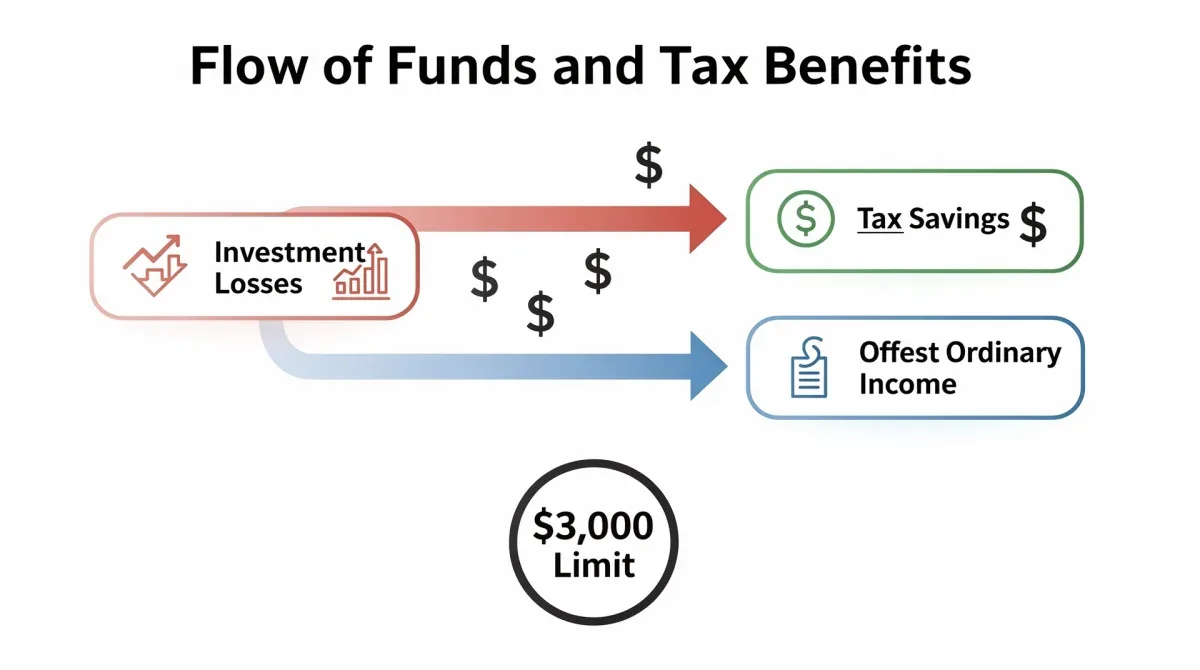
Furthermore, any remaining capital losses, up to $3,000 per year, can be used to offset ordinary income, such as wages or interest. This provision makes tax-loss harvesting a valuable tool for reducing taxable income beyond just capital gains.
Identifying Eligible Investments for Harvesting
- Stocks: Individual equities that have declined in value since acquisition.
- Bonds: Fixed-income securities, especially those sensitive to interest rate changes.
- Mutual Funds/ETFs: Broad market or sector-specific funds experiencing losses.
- Real Estate Investment Trusts (REITs): Publicly traded real estate investments.
The key is to identify investments currently trading below their cost basis. This creates the unrealized loss that, once realized through sale, becomes a deductible capital loss. Timing is crucial, as market recoveries can quickly erase these opportunities.
Step-by-Step Guide to Offsetting $3,000 in Ordinary Income
Implementing Tax-Loss Harvesting in Volatile Markets: Step-by-Step Guide to Offsetting $3,000 in Ordinary Income requires a structured approach. The first step involves reviewing your investment portfolio to identify assets currently trading at a loss. This requires access to your cost basis information for each security.
Once potential losses are identified, carefully consider which assets to sell. It's important to weigh the tax benefits against your long-term investment strategy. Selling a losing asset might be beneficial for tax purposes, but only if it aligns with your overall financial goals.
The next critical step is executing the sale and documenting the loss. This loss can first offset any capital gains you have. If your capital losses exceed your capital gains, you can then use up to $3,000 of the remaining loss to offset your ordinary income.
Key Considerations for Maximizing Benefits
- Cost Basis Accuracy: Ensure your brokerage statements accurately reflect your purchase prices.
- Wash-Sale Rule: Avoid repurchasing a substantially identical security within 30 days before or after the sale.
- Tax Bracket Impact: Understand how capital losses will affect your specific tax situation.
- Year-End Timing: Losses must be realized by December 31st to count for the current tax year.
Proper documentation and adherence to IRS regulations are paramount. Consulting with a financial advisor or tax professional can help ensure compliance and optimize the strategy for your individual circumstances.
Navigating the Wash-Sale Rule Effectively
The wash-sale rule is a critical IRS regulation designed to prevent investors from claiming artificial losses for tax purposes. It states that if you sell a security at a loss and then buy a substantially identical security within 30 days before or after the sale, the loss is disallowed.
Understanding and carefully navigating this rule is essential for successful Tax-Loss Harvesting in Volatile Markets: Step-by-Step Guide to Offsetting $3,000 in Ordinary Income. If a wash sale occurs, the disallowed loss is typically added to the cost basis of the newly purchased security, deferring the tax benefit rather rather than eliminating it entirely.
To avoid triggering the wash-sale rule, investors have several options. One common strategy is to purchase a similar, but not substantially identical, security. For example, if you sell an S&P 500 index ETF at a loss, you might buy a total stock market index ETF or a different S&P 500 ETF from a different provider.
Strategies to Bypass the Wash-Sale Rule
- Buy a different, non-identical security: Invest in a fund tracking a different index or sector.
- Wait 31 days: Simply wait the required period before repurchasing the same security.
- Sell and buy a different asset class: Shift funds to bonds or other investment types temporarily.

Another approach is to simply wait the 31-day period before repurchasing the identical security. While this might mean missing out on a short-term market rebound, it ensures the tax loss is legitimately recognized.
Case Study: A Practical Application
Consider an investor, John, who in a volatile market year, had $5,000 in capital gains from selling a growth stock and $8,000 in unrealized losses from a technology ETF. He decides to implement Tax-Loss Harvesting in Volatile Markets: Step-by-Step Guide to Offsetting $3,000 in Ordinary Income.
John sells his technology ETF, realizing an $8,000 capital loss. This loss first offsets his $5,000 capital gains, reducing his net capital gains to zero. The remaining $3,000 capital loss can then be used to offset $3,000 of his ordinary income, such as his salary.
This strategy effectively reduces John's taxable income by $3,000, leading to significant tax savings. Without tax-loss harvesting, John would have paid taxes on his $5,000 capital gains and his full ordinary income.
Impact on Overall Tax Liability
By offsetting $3,000 in ordinary income, John reduces his adjusted gross income (AGI), which can have cascading effects. A lower AGI can potentially qualify him for other tax credits or deductions that have income limitations.
This example highlights the dual benefit of tax-loss harvesting: eliminating capital gains tax for the year and directly reducing ordinary income. The $3,000 offset limit for ordinary income is a consistent and valuable component of this strategy.
The Role of Automated Tools and Financial Advisors
In today's complex financial landscape, numerous automated tools and platforms are available to assist investors with Tax-Loss Harvesting in Volatile Markets: Step-by-Step Guide to Offsetting $3,000 in Ordinary Income. These tools can monitor portfolios, identify harvesting opportunities, and even execute trades while adhering to tax rules like the wash-sale rule.
Robo-advisors, for instance, often incorporate tax-loss harvesting as a standard feature in their portfolio management services. They automatically look for opportunities to sell securities at a loss and replace them with similar, non-identical investments, optimizing tax efficiency without active intervention from the investor.
However, for more complex financial situations or those who prefer personalized guidance, consulting with a qualified financial advisor or tax professional is invaluable. These experts can provide tailored advice, consider individual tax situations, and ensure compliance with all relevant IRS regulations.
Benefits of Professional Guidance
- Personalized Strategy: Tailored advice based on your unique financial goals and risk tolerance.
- Compliance Assurance: Expert knowledge of tax laws, including the wash-sale rule.
- Optimized Outcomes: Maximizing tax savings while maintaining portfolio integrity.
Whether utilizing automated tools or professional advisors, the goal remains the same: to strategically manage investments to reduce tax burdens, particularly during periods of market volatility.
Long-Term Planning and Future Implications
While Tax-Loss Harvesting in Volatile Markets: Step-by-Step Guide to Offsetting $3,000 in Ordinary Income offers immediate tax benefits, its implications extend into long-term financial planning. Unused capital losses, exceeding the $3,000 ordinary income offset, can be carried forward indefinitely to offset future capital gains and ordinary income.
This carryforward provision ensures that no realized loss is ever truly wasted, providing a continuous benefit in subsequent tax years. It allows investors to build up a reserve of tax losses that can be deployed strategically in future periods, regardless of market conditions.
Integrating tax-loss harvesting into a broader financial plan involves regular portfolio reviews and proactive tax planning. This ongoing attention can significantly enhance after-tax returns over an investor's lifetime, contributing to greater wealth accumulation.
Strategic Carryforward of Losses
- Future Capital Gains: Use carried-over losses to offset gains from profitable sales.
- Future Ordinary Income: Continue to offset up to $3,000 of ordinary income annually.
- Estate Planning: Losses can potentially be utilized by heirs, depending on regulations.
The ability to carry forward losses makes tax-loss harvesting a powerful, multi-year strategy, turning temporary market setbacks into lasting financial advantages. This foresight is a hallmark of sophisticated wealth management.
Common Misconceptions and Best Practices
One common misconception about Tax-Loss Harvesting in Volatile Markets: Step-by-Step Guide to Offsetting $3,000 in Ordinary Income is that it requires selling all losing assets. In reality, it's about selectively realizing losses that provide the most tax advantage while maintaining a diversified portfolio.
Another misunderstanding is that the wash-sale rule applies only to identical securities. While true, 'substantially identical' can be interpreted broadly, so careful consideration is needed when replacing assets. Simply buying an ETF from a different provider might not always suffice if the underlying index is the same.
Best practices dictate a clear understanding of your investment goals, tax situation, and the regulatory landscape. Regular consultation with a tax professional or financial advisor can help demystify the process and avoid costly errors.
Key Best Practices for Investors
- Maintain detailed records: Keep accurate records of all trades, cost bases, and sale prices.
- Understand the wash-sale rule: Know what constitutes a 'substantially identical' security.
- Don't let the tax tail wag the investment dog: Ensure tax decisions align with your long-term investment strategy.
Ultimately, tax-loss harvesting is a tool to optimize returns, not to dictate investment decisions. It should complement, not override, sound investment principles.
| Key Point | Brief Description |
|---|---|
| Maximize Tax Savings | Utilize realized investment losses to offset capital gains and up to $3,000 of ordinary income. |
| Navigate Volatility | Volatile markets offer prime opportunities to identify and realize investment losses for tax benefits. |
| Wash-Sale Rule | Avoid repurchasing substantially identical securities within 30 days to ensure loss deductibility. |
| Carryforward Losses | Unused capital losses can be carried forward indefinitely to offset future income. |
Frequently Asked Questions About Tax-Loss Harvesting
What is the primary benefit of tax-loss harvesting?▼The main benefit is reducing your taxable income. By realizing losses, you can offset capital gains, and then deduct up to $3,000 of any remaining net capital loss against your ordinary income, leading to direct tax savings.
How does market volatility impact tax-loss harvesting?▼Volatile markets create more opportunities to identify and realize losses in your portfolio. When asset values temporarily decline, investors can strategically sell these assets to generate tax losses that can be used to offset gains.
What is the wash-sale rule and why is it important?▼The wash-sale rule prevents you from claiming a loss if you buy a substantially identical security within 30 days before or after selling it at a loss. It's crucial to understand to ensure your harvested losses are legitimate for tax purposes.
Can I offset more than $3,000 in ordinary income?▼No, the IRS limits the amount of net capital loss you can deduct against ordinary income to $3,000 per year. However, any losses exceeding this amount can be carried forward to offset income in future tax years indefinitely.
When is the best time to perform tax-loss harvesting?▼While opportunities can arise anytime, many investors perform tax-loss harvesting towards the end of the year, usually in November or December. This allows them to assess their year-to-date gains and losses and plan accordingly before the December 31st deadline.
What this means
The strategic implementation of Tax-Loss Harvesting in Volatile Markets: Step-by-Step Guide to Offsetting $3,000 in Ordinary Income offers a significant avenue for investors to optimize their tax situation. It transforms market downturns into opportunities for tax savings, impacting both current and future tax liabilities. Investors should remain vigilant, continuously review their portfolios, and consider professional guidance to fully leverage this powerful financial strategy in the dynamic economic landscape of the United States.