Real Estate Syndication Worth It? 8% Preferred vs. REITs 2026
Advertisements
In 2026, U.S. real estate investors are weighing 8% preferred returns in private syndications against public REIT dividend yields averaging around 3% to 5%. Here is a concise breakdown of how the two structures compare on liquidity, tax treatment, and risk—and what to monitor next.
Understanding Real Estate Syndication and Preferred Returns
Real estate syndication pools capital from multiple investors to acquire, manage, and eventually sell properties. This structure allows individual investors to participate in larger real estate projects than they could on their own, often managed by experienced sponsors.
A key feature of many syndications is the preferred return, which is a payment priority to investors before the sponsor receives any profit. An 8% preferred return means investors receive the first 8% of distributable cash flow annually before the general partner participates in the profits.
This structure is designed to offer a level of income stability and downside protection for limited partners, making the investment potentially more attractive. However, it is essential to understand that preferred returns are not guaranteed and depend on the property's performance.
The appeal of an 8% preferred return in real estate syndication lies in its potential for consistent income distributions. This steady income stream can be particularly attractive to investors seeking cash flow, contrasting with the often more volatile nature of public market investments.
Furthermore, syndications often offer tax advantages, such as depreciation, which can offset taxable income. These benefits contribute to the overall attractiveness of real estate syndication as a wealth-building strategy.
However, investors must conduct thorough due diligence on both the syndication deal itself and the sponsor's track record. The success of a real estate syndication largely hinges on the expertise and integrity of the general partner.
Public REITs: Yields, Liquidity, and Market Dynamics in 2026
Public Real Estate Investment Trusts (REITs) offer another avenue for real estate exposure, allowing investors to buy shares in companies that own, operate, or finance income-producing real estate. REITs trade on major stock exchanges, providing significant liquidity compared to private syndications.
REITs are legally required to distribute at least 90% of their taxable income to shareholders annually in the form of dividends. This makes them attractive for income-focused investors, similar to the appeal of preferred returns in syndications, but with different risk and liquidity profiles.
Projections for public REIT yields in 2026 suggest a dynamic environment influenced by interest rates, economic growth, and specific sector performance. Investors should monitor these macroeconomic factors closely, as they significantly impact REIT valuations and dividend sustainability.
The liquidity of public REITs means investors can buy or sell shares easily, offering flexibility that private real estate syndication does not. This ease of entry and exit can be a major advantage for those who prioritize access to their capital.
However, REIT prices can be volatile, reflecting broader stock market movements and investor sentiment, sometimes decoupling from the underlying real estate asset values. This market-driven volatility is a key distinction from the typically less liquid, but also less publicly traded, syndication model.
Sector-specific REITs, focusing on areas like industrial, residential, or data centers, may perform differently depending on economic trends. Diversification across various REIT sectors can mitigate risks associated with over-exposure to a single property type.
Comparing 8% Preferred Returns vs. Public REIT Yields
The fundamental question of Is Real Estate Syndication Worth It? Analyzing 8% Preferred Returns vs. Public REIT Yields in 2026 centers on risk-adjusted returns, liquidity, and control. An 8% preferred return in syndication offers a fixed income priority, but typically comes with illiquidity for several years.
Public REIT yields, while offering daily liquidity, are subject to market volatility and may not always provide a predictable income stream, especially during economic downturns. The 'preferred' nature of syndication returns provides a psychological comfort, but it's crucial to remember it's not a guarantee of capital return.
Investors must weigh their personal financial goals, risk tolerance, and time horizon when deciding between these two investment vehicles. Each offers distinct advantages and disadvantages that cater to different investor profiles.
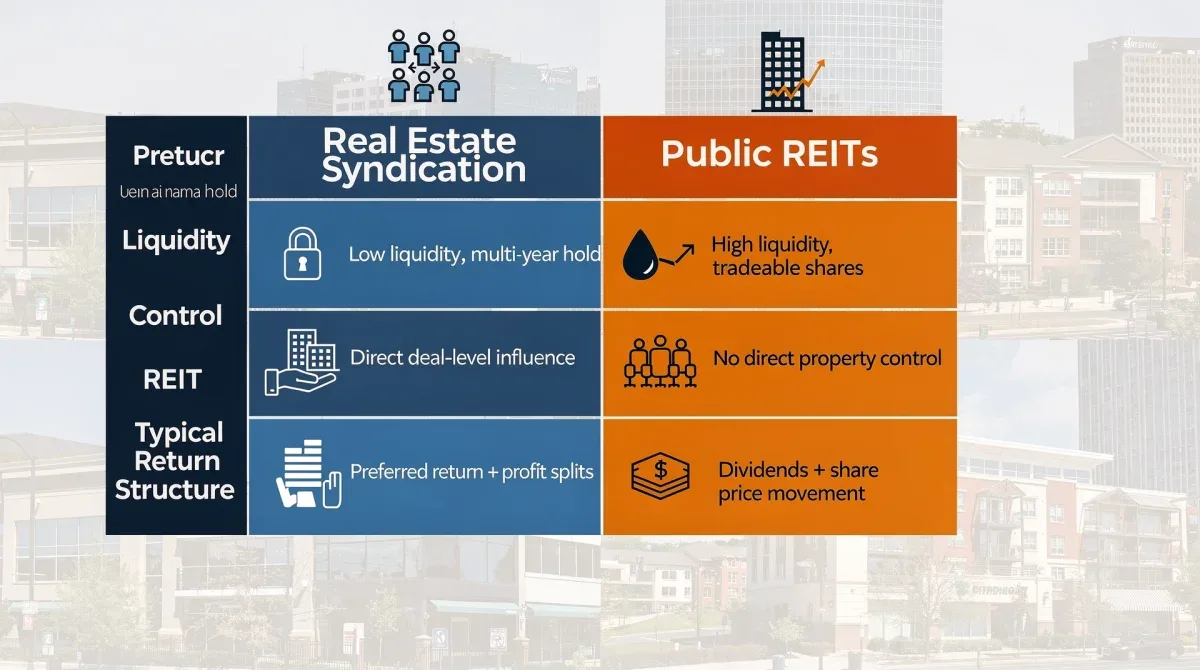
One significant difference lies in control and transparency. In a real estate syndication, investors typically have less direct control over the asset, relying heavily on the sponsor's management. However, they often receive detailed updates on the specific property's performance.
REIT investors, on the other hand, have no direct control over the underlying properties but benefit from the transparency of publicly traded companies, including regular financial reporting and analyst coverage. This level of oversight can be reassuring for some investors.
Ultimately, the choice hinges on whether an investor prioritizes the potential for higher, but less liquid, preferred returns in a private deal, or the liquidity and broad market exposure offered by public REITs, even with their inherent market risks.
Liquidity and Investment Horizon Considerations
Liquidity is a critical factor when evaluating Is Real Estate Syndication Worth It? Analyzing 8% Preferred Returns vs. Public REIT Yields in 2026. Real estate syndications are inherently illiquid investments, meaning capital is typically locked up for several years, often 5 to 10 years, until the property is sold or refinanced.
This long-term commitment requires investors to have a stable financial position and not need access to their funds for the duration of the investment. The potential for higher returns often compensates for this lack of liquidity, but it is a trade-off that must be carefully considered.
Public REITs, by contrast, offer daily liquidity, allowing investors to buy and sell shares on stock exchanges. This flexibility is a significant advantage for those who may need to access their capital quickly or prefer to adjust their portfolio frequently based on market conditions.
However, this liquidity comes at a price: REIT share prices can fluctuate significantly, sometimes unrelated to the underlying value of the real estate. This market volatility introduces a different set of risks compared to the illiquidity of syndications.
The Illiquidity Premium in Syndications
Higher Potential Returns: Investors in illiquid assets often demand a premium for tying up their capital. This can translate into potentially higher returns in successful syndications compared to more liquid alternatives.
Long-Term Strategy: Syndications are ideal for investors with a long-term investment horizon who can afford to wait for the full cycle of the real estate project.
Reduced Market Noise: The illiquid nature means investors are less likely to make impulsive decisions based on short-term market fluctuations, fostering a disciplined investment approach.
The investment horizon should align with the chosen vehicle. For those with a shorter horizon or a need for flexibility, public REITs might be more suitable. For long-term investors focused on wealth accumulation and accepting illiquidity, real estate syndication worth the consideration.
Risk Profiles and Due Diligence
Every investment carries risk, and understanding these profiles is crucial for determining Is Real Estate Syndication Worth It? Analyzing 8% Preferred Returns vs. Public REIT Yields in 2026. Real estate syndications involve risks specific to the underlying property, market conditions, and the sponsor's execution capabilities.
Key risks include vacancy, unexpected operational costs, interest rate fluctuations impacting refinancing, and market downturns that could affect property values. The success heavily depends on the general partner's experience and ability to manage these factors effectively.
Thorough due diligence on the sponsor, the market, and the specific property is paramount before investing in a syndication. Investors must scrutinize financial projections, legal documents, and the sponsor's track record to mitigate potential pitfalls.

Public REITs, while offering diversification across multiple properties and professional management, are exposed to stock market risks. Their prices can be influenced by broader economic sentiment, interest rate changes, and sector-specific news, even if the underlying real estate is performing well.
Additionally, REITs carry their own set of operational risks, such as management effectiveness and capital allocation decisions. Investors should research the management teams of REITs, their debt levels, and their historical performance.
Key Due Diligence Areas for Syndications
Sponsor Track Record: Investigate past projects, communication style, and investor payouts.
Market Analysis: Assess the local economic conditions, supply and demand dynamics, and growth prospects of the property's location.
Deal Structure: Understand the equity split, fee structure, and preferred return mechanisms to ensure alignment of interests.
The differing risk profiles mean that investors must align their investment choices with their personal comfort level for risk. While syndications can offer attractive returns, they demand a deeper dive into specific deal details and sponsor reliability.
Tax Implications and Financial Planning
Understanding the tax implications is another vital component in evaluating Is Real Estate Syndication Worth It? Analyzing 8% Preferred Returns vs. Public REIT Yields in 2026. Real estate syndications often provide significant tax benefits, primarily through depreciation write-offs.
Depreciation allows investors to deduct a portion of the property's value each year, which can offset passive income and sometimes even active income, depending on investor status. These deductions can effectively reduce the taxable income generated by the investment, enhancing net returns.
However, these benefits can be complex and require careful tax planning, often with the assistance of a qualified tax professional. The passive nature of most syndication investments means that passive losses can generally only offset passive income, a rule investors must be aware of.
Public REITs also have specific tax treatments. Dividends from REITs are generally taxed as ordinary income, which can be higher than qualified dividend rates for other stocks. This is because REITs distribute most of their income before corporate taxes.
However, a portion of REIT dividends may qualify for a 20% deduction under Section 199A of the tax code, which can reduce the effective tax rate. Investors should consult with a tax advisor to understand how REIT dividends will impact their overall tax liability.
Tax Advantages of Syndications
Depreciation: Non-cash expense that reduces taxable income, potentially creating passive losses.
Cost Segregation: Accelerates depreciation on certain property components, further enhancing tax benefits.
1031 Exchanges: Potential to defer capital gains tax by reinvesting proceeds into another like-kind property.
The tax efficiency of real estate syndication can significantly boost overall returns, making it a compelling factor for high-net-worth individuals and sophisticated investors. However, the complexities necessitate professional guidance to maximize these benefits.
Market Outlook for 2026: Real Estate and Interest Rates
The market outlook for 2026 will profoundly influence whether Is Real Estate Syndication Worth It? Analyzing 8% Preferred Returns vs. Public REIT Yields in 2026. Economic forecasts suggest continued, albeit moderate, growth in the U.S. economy, which bodes well for real estate fundamentals.
Interest rates are expected to stabilize or potentially see modest adjustments, impacting both the cost of financing for syndications and the attractiveness of REIT dividends relative to other fixed-income investments. Higher interest rates typically put pressure on real estate valuations and increase borrowing costs.
Specific real estate sectors will likely perform differently. Industrial and multi-family properties may continue to show resilience, while office space could face ongoing challenges due to evolving work patterns. These sector-specific trends are crucial for both syndication and REIT performance.
Inflationary pressures, while easing, could still play a role in operating costs and rental growth. Syndications with strong rent growth potential and efficient management will be better positioned to navigate these dynamics.
Geographic trends also matter; certain markets in the U.S. are experiencing stronger population and job growth, making them more attractive for real estate investment. Investors should consider these regional disparities when evaluating opportunities.
Key Market Influencers for 2026
Interest Rate Trajectory: Impacts borrowing costs for syndicators and the discount rate for REIT valuations.
Economic Growth: Drives demand for commercial and residential real estate, influencing occupancy and rental rates.
Sectoral Performance: Different property types (e.g., industrial, residential, retail, office) will have varying outlooks based on evolving economic and social trends.
The overall economic stability and predictable interest rate environment would generally favor both real estate syndication and REITs, but individual performance will largely depend on specific deal quality and market-specific factors.
Strategic Investment Approaches for 2026
Considering the analysis, developing a strategic investment approach for 2026 is essential for those asking Is Real Estate Syndication Worth It? Analyzing 8% Preferred Returns vs. Public REIT Yields in 2026. A diversified portfolio often includes both private and public real estate exposure.
For investors prioritizing higher potential returns and comfortable with illiquidity, well-vetted real estate syndications offering 8% preferred returns can be a compelling option. The key is rigorous due diligence on the sponsor and the underlying asset.
Conversely, for those seeking liquidity, broad market exposure, and consistent dividends, public REITs remain a viable choice. Diversifying across different REIT sectors can help mitigate risks associated with specific property types.
A hybrid approach, where investors allocate a portion of their portfolio to syndications for growth and income potential, and another portion to REITs for liquidity and diversified exposure, could offer an optimal balance. This strategy allows investors to capture benefits from both worlds.
Monitoring economic indicators, interest rate forecasts, and specific real estate sector performance will be crucial for adjusting strategies throughout 2026. Flexibility and adaptability will be key to navigating the evolving real estate market.
Considerations for a Balanced Portfolio
Risk Tolerance: Align investments with personal comfort for market volatility and illiquidity.
Financial Goals: Determine whether the primary objective is cash flow, capital appreciation, or a combination.
Market Timing: While difficult to predict, understanding cycles can inform entry and exit points for REITs and syndications.
Ultimately, the decision of whether real estate syndication is worth it depends on individual circumstances and a thorough understanding of the distinct characteristics of both syndications and REITs.
Key Investment Aspect | Syndication vs. REITs |
|---|---|
Preferred Returns | Syndications often offer 8% preferred returns, prioritizing investor payouts before sponsors. |
Liquidity | REITs offer daily liquidity on public exchanges; syndications are illiquid for years. |
Risk Profile | Syndications have property-specific risks; REITs face market volatility and sector risks. |
Tax Benefits | Syndications offer depreciation advantages; REIT dividends are typically taxed as ordinary income. |
Frequently Asked Questions on Real Estate Syndication and REITs
What exactly is a preferred return in real estate syndication?▼
A preferred return is a threshold return that limited partners (investors) in a real estate syndication must receive before the general partner (sponsor) can participate in profit distributions. For example, an 8% preferred return means investors get the first 8% of annual cash flow, enhancing their income priority.
How does liquidity differ between syndications and REITs?▼
Real estate syndications are generally illiquid, requiring investors to commit capital for several years until the asset is sold or refinanced. Public REITs, conversely, trade on stock exchanges, offering daily liquidity for investors to buy or sell shares as needed, providing greater flexibility.
Are 8% preferred returns guaranteed in real estate syndication?▼
No, an 8% preferred return is not guaranteed. It represents a priority in the distribution waterfall, meaning investors receive the first 8% if the property generates sufficient cash flow. If the property underperforms, the preferred return may not be met, and it is not a debt obligation.
What are the main tax benefits of real estate syndication?▼
Real estate syndications offer significant tax advantages, primarily through depreciation write-offs, which can reduce taxable income. Other benefits can include cost segregation studies to accelerate depreciation and potential for 1031 exchanges to defer capital gains upon sale, enhancing net returns.
What factors should I consider when choosing between syndication and REITs for 2026?▼
When choosing, consider your risk tolerance, liquidity needs, and investment horizon. Syndications suit long-term investors seeking higher potential returns and tax benefits despite illiquidity. REITs are better for those prioritizing liquidity, diversified exposure, and consistent dividends with market volatility.
Looking Ahead: Navigating Real Estate Investments in 2026
The evolving financial landscape for 2026 underscores the necessity for informed decision-making regarding real estate investments.
Deciding between real estate syndication—with structures like 8% preferred returns—and public REIT yields depends heavily on individual investor profiles, liquidity preferences, and broader market conditions.
For a detailed comparison of structural trade-offs, tax advantages, and minimum requirements, explore Rise48 Equity's breakdown of real estate syndication vs. REITs.
Monitoring interest rate policies, economic growth, and specific sector performance will remain crucial as investors conduct thorough due diligence and build diversified portfolios in the coming years.